
The 4 Types of Hunger
August 11, 2021Two of the ten principles in Intuitive Eating are about hunger and its absence (“Honor your Hunger” and “Respect your fullness”).
Maybe the first thing that comes to your mind when thinking about hunger is a rumbling stomach, a gnawing sensation, and the need for energy. Those are signs of physical hunger, but did you know that there are more ways of experiencing hunger than just physical hunger?
In fact, it can be differentiated between four types of hunger: physical hunger, emotional hunger, taste hunger, and practical hunger. While all types of hunger are valid and real, it can be helpful to distinguish between them and find out what might fuel your desire to eat so you can better respond to your body´s cues.
1. Physical Hunger
Physical hunger is your body´s way of signaling its need for energy from food. Just like thirst is the sign that you need to drink some water, and a full bladder is a sign that you need to pee, physical hunger is the sign that you need to eat something. Physical hunger can present as an empty sensation in the stomach, belly rumbling, or outside the stomach as fatigue, headaches, dizziness, or shakiness. If you have difficulties recognizing early signs of physical hunger, the hunger-fullness scale might be a helpful tool for you. Despite many “fitness influencers” or weight loss coaches telling you to drink a glass of water, chew some gum, or go for a walk when you´re feeling hungry, the only way to respond to and satisfy physical hunger is by eating food!
2. Taste Hunger
Taste hunger is the sensation you get when you want to eat something specific just because you like the taste of it. Taste hunger might appear alongside physical hunger or outside of it. Imagine being at a restaurant with your friends or family and you´re already full from your delicious dinner when the waiter brings the dessert menu full of cake, ice cream, crème brulée,… Even though you´re already full, you still want to eat some dessert, just because it sounds so delicious. That´s a perfect example of pure taste hunger. And of course, you are allowed to give in to that sensation and have some dessert!
Taste hunger usually is satisfied by eating a small bowl of ice cream, a spoonful of Nutella, a handful of chips, a slice of cheese, a chocolate bar, or something like that. Sometimes we need to eat according to our taste hunger in order to fill the gap between feeling full and satisfied after our meal. Remember, it is totally okay to eat in response to your taste hunger even if you´re not physically hungry! However, if you know that more delicious food will be available later or you´re already full and satisfied, you might not feel the urge to react to every taste hunger you´re experiencing.
3. Emotional Hunger
Similar to taste hunger, emotional hunger expresses itself as cravings for a specific type of food. But unlike taste hunger which is usually satisfied by a small amount of whatever food you have in mind, emotional hunger mostly doesn´t disappear by eating.
That´s when you know something else is going on. Emotional hunger is an unmet emotional need (e.g. a need for security, belonging, or purpose) presenting itself as the desire to eat food. Emotional hunger is your body´s way of telling you that something is wrong and needs to be addressed.
Emotional hunger can lead to emotional eating, i.e. eating in order to soothe uncomfortable emotions. Emotional eating is a valid strategy, a coping mechanism and it is not inherently bad.
It is concerning though when turning to food is the only coping mechanism and you don´t know any other practice to process negative (or positive) emotions.
Sometimes, it can be difficult to distinguish between physical and emotional hunger so here´s an overview of signs to look out for:
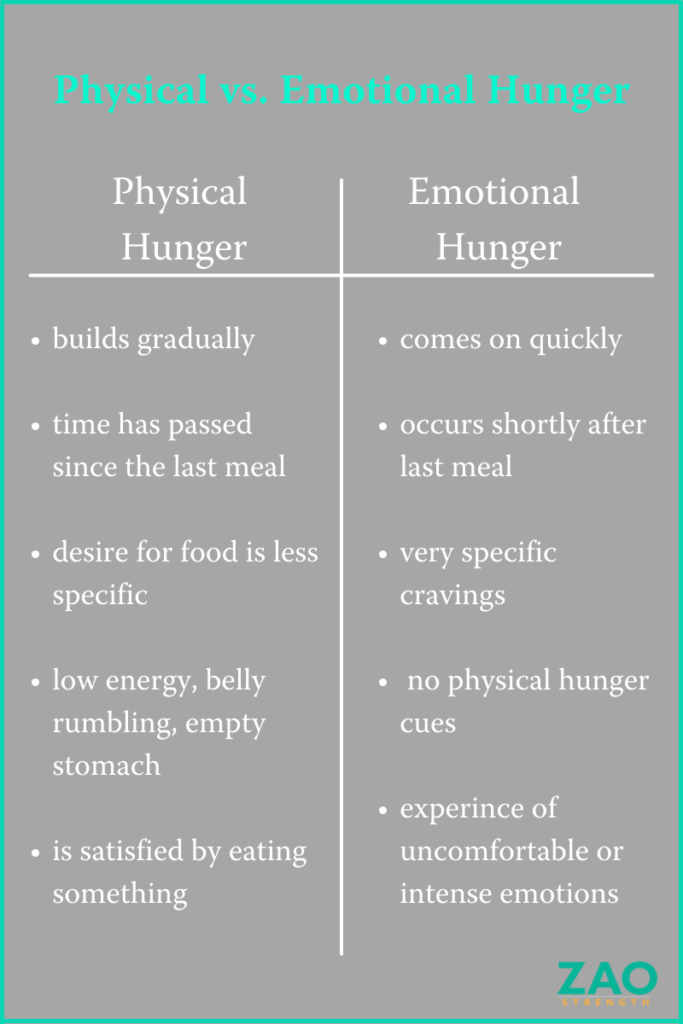
After identifying your emotional hunger, the tricky part is finding out what you´re feeling. It can be really hard to allow yourself to feel your feelings when you´re used to stuffing them down with food.
However, once you´ve identified what is going on inside of you, you can consider coping mechanisms and strategies to meet your emotional needs without using food.
Don´t get me wrong, it is 100% okay to engage in emotional eating! However, unlike physical hunger, emotional hunger cannot be satisfied by just food, and it might be useful to build up your emotional coping toolbox.
Examples for self-care practices that might help satisfy your emotional hunger/your emotional needs include:
1. Journaling
2. Calling a Friend
3. Taking a break
4. Napping
5. Setting Boundaries
6. Checking in regularly with your friends and family
7. Spending time in nature
9. Dancing
10. Crying
11. Going to therapy
Experiment with different self-care practices that you enjoy until you notice a benefit!
4. Practical Hunger
Practical hunger isn´t really the sensation of wanting to eat something but rather the need to consume food in response to anticipated physical hunger that you won´t be able to satisfy. In our everyday lives, we don´t always have access to food or the opportunity to eat as soon as hunger hits.
For example, when having back-to-back meetings, or are stuck in a long plane flight.
In order to prevent getting overly hungry in situations like these, we might want to engage in practical eating and have a snack or meal even though we´re not experiencing physical hunger: Practical eating also helps with avoiding overeating as a response to longer periods of food deprivation and keeps our energy levels, mood, and digestion stable.
Summary
All four types of hunger are valid and eating in response to them is always appropriate!
That being said, understanding the type of hunger you are experiencing can be helpful in finding a way to satisfy it the best.
For example, while physical hunger might require you to eat a larger snack or meal, taste hunger usually can be satisfied with a little something. For satisfying your emotional hunger, you might want to eat something or use another coping strategy that helps you meet your emotional needs.
As always, there are no rules!